| ☁ London 16°C

Kenya Aviation Workers End Strike After Major Flight Disruptions

Kenya aviation workers have ended a strike that disrupted flights at Jomo Kenyatta International Airport and several other airports, after the workers’ union and government authorities reached a return-to-work agreement.
The Kenya aviation workers strike had caused widespread delays and cancellations, leaving passengers stranded and disrupting domestic and international travel.
The Kenya Aviation Workers’ Union (KAWU) called off the industrial action on Tuesday and instructed affected members to resume normal duties following negotiations involving government officials, aviation authorities and industry representatives.
The agreement paved the way for flight operations to gradually return to normal at Jomo Kenyatta International Airport (JKIA), Kenya’s main international aviation hub, as well as other airports around the country.
Kenya aviation workers strike ends after agreement
The industrial action began on Sunday, August 30, following unresolved disputes between workers and aviation-sector organizations.
The strike affected operations involving the Kenya Civil Aviation Authority (KCAA), Kenya Airports Authority (KAA) and Jambojet.
Among the workers’ concerns were collective bargaining agreements, salary reviews, union-related payments and allegations of victimisation of union members.
Negotiations continued through Monday night before government officials and union representatives reached an agreement early Tuesday.
Transport Cabinet Secretary Davis Chirchir led the negotiations, with Labour Cabinet Secretary Alfred Mutua, union representatives and aviation-sector executives among those involved.
The parties ultimately signed a return-to-work agreement allowing normal aviation operations to resume.
Flights delayed and passengers stranded
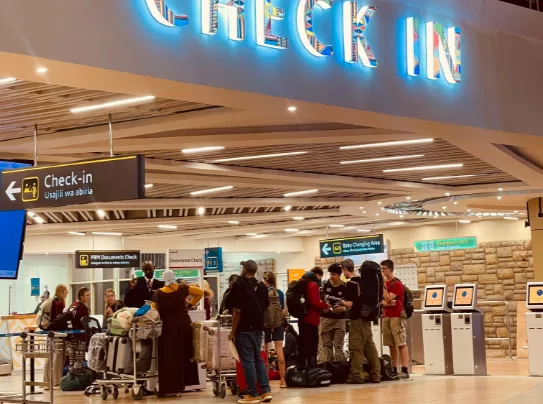
The strike caused significant disruption at Jomo Kenyatta International Airport in Nairobi, one of East Africa’s busiest aviation hubs.
Flights were delayed or cancelled as disruptions to air traffic control and other airport services affected operations.
The industrial action also affected Moi International Airport in Mombasa, Eldoret International Airport and Kisumu International Airport.
Kenya Airways had warned passengers about significant delays, while other airlines adjusted or cancelled flights.
The effects were not confined to Kenya. Reuters reported disruptions involving routes serving destinations including Rwanda, Burundi, Tanzania, Uganda, Somalia and Mauritius.
What did the government and workers agree?
A key part of the agreement involves negotiations between KAWU and the Kenya Civil Aviation Authority over a Collective Bargaining Agreement (CBA).
The parties agreed that CBA negotiations would proceed, with KCAA management expected to honour and implement the eventual outcome.
The Kenya Airports Authority also agreed to release and remit union agency fees being held on behalf of KAWU.
A separate dispute involving union recognition at Jambojet remains subject to an ongoing court process.
The government also committed to addressing other grievances raised by workers through established dispute-resolution mechanisms.
Airport operations begin returning to normal
Operations began recovering after workers returned to their duties, although passengers continued to experience some delays as airlines worked through the backlog.
Jambojet warned customers that some delays could continue while schedules were restored, with normal scheduled operations expected by Wednesday, September 2.
Later Tuesday, the Kenya Airports Authority said major airports had handled 244 flights between 3 a.m. and noon, including arrivals and departures.
JKIA handled 55 flights during that period, while Wilson Airport handled 140, Moi International Airport 23, Kisumu International Airport 12 and Eldoret International Airport 14.
The figures provided an early indication that aviation operations were recovering after days of disruption.
Why the strike matters for Kenya
JKIA is a major aviation gateway for Kenya and the wider East African region, connecting international passengers and cargo with destinations across Africa and beyond.
Disruptions at the airport can therefore affect tourism, trade, business travel and regional aviation networks.
The strike also highlighted longstanding labour disputes within Kenya’s aviation industry and the importance of resolving employment disagreements before they significantly disrupt critical transport infrastructure.
Although workers have now returned to their duties, attention will turn to whether the agreements reached between the government, aviation authorities and KAWU resolve the underlying issues.
BBNN will continue to monitor developments in Kenya’s aviation sector and provide updates as more information becomes available.